Concept for the UM rhythm study

Build America to the beat.

Tempo Trek is a research-grade iPad rhythm game that children aged 8 to 12 will want to play for six weeks, and that hands your team clean timing data from every tap, every silent beat and every spoken syllable.

Concept video, 38 seconds. Captured from the working iPad build.Full quality video
What the child plays

Four activities, one road trip.

The child road-trips across the United States and rebuilds a famous monument in every city by keeping the beat. Two tap-to-the-beat activities, a rhythm discrimination activity and a speech rhythm probe cover both speech and nonspeech rhythm. Every activity adapts to the child and runs in short two to four minute chunks so a thirty minute session feels like a run of quick wins.

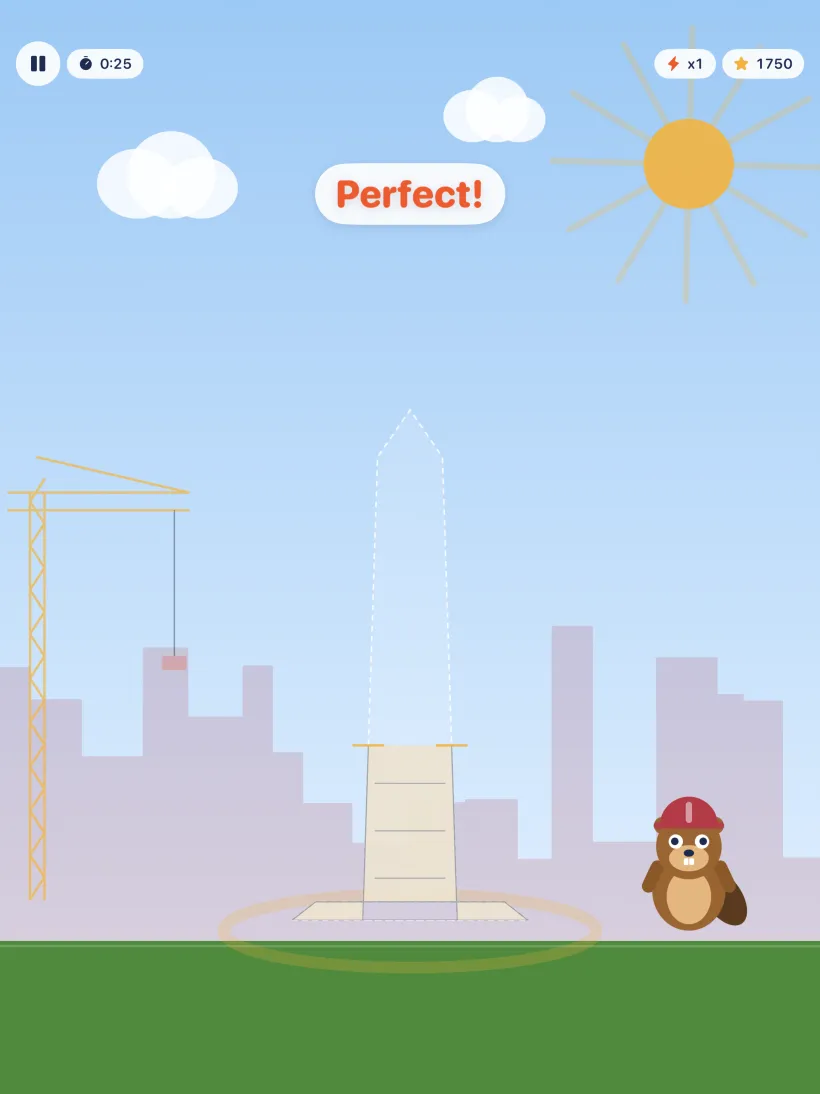
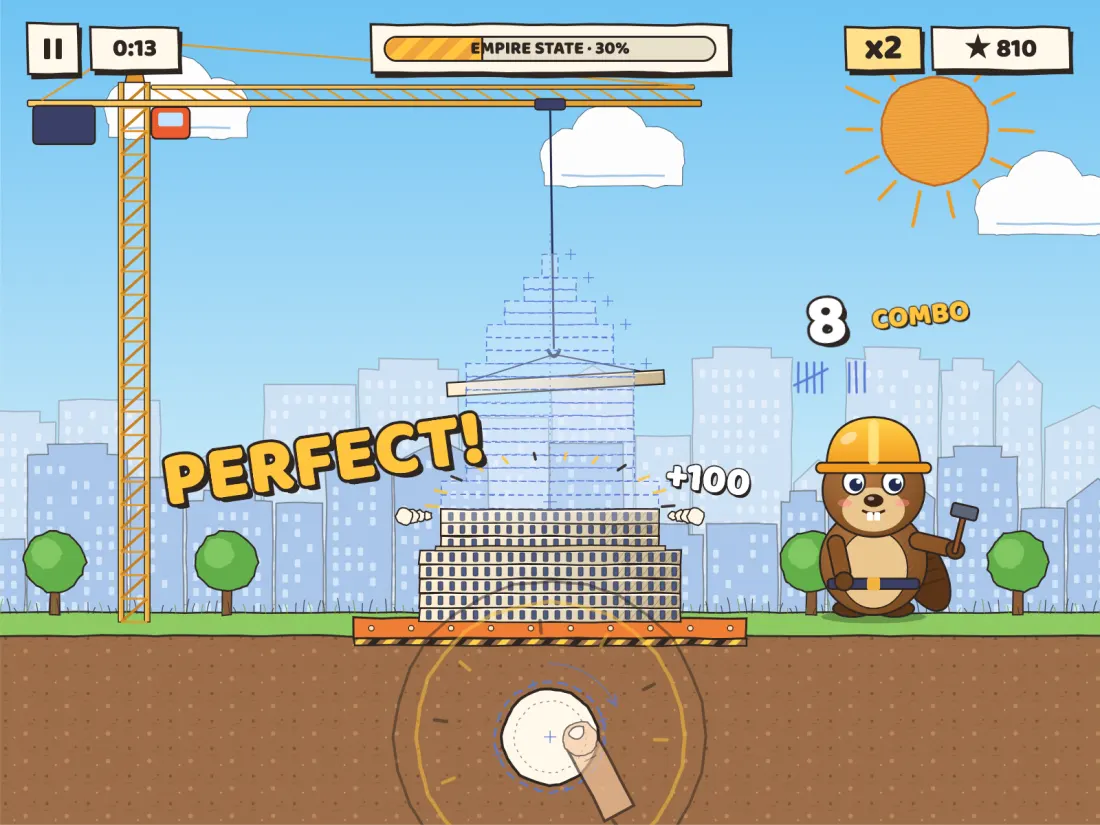
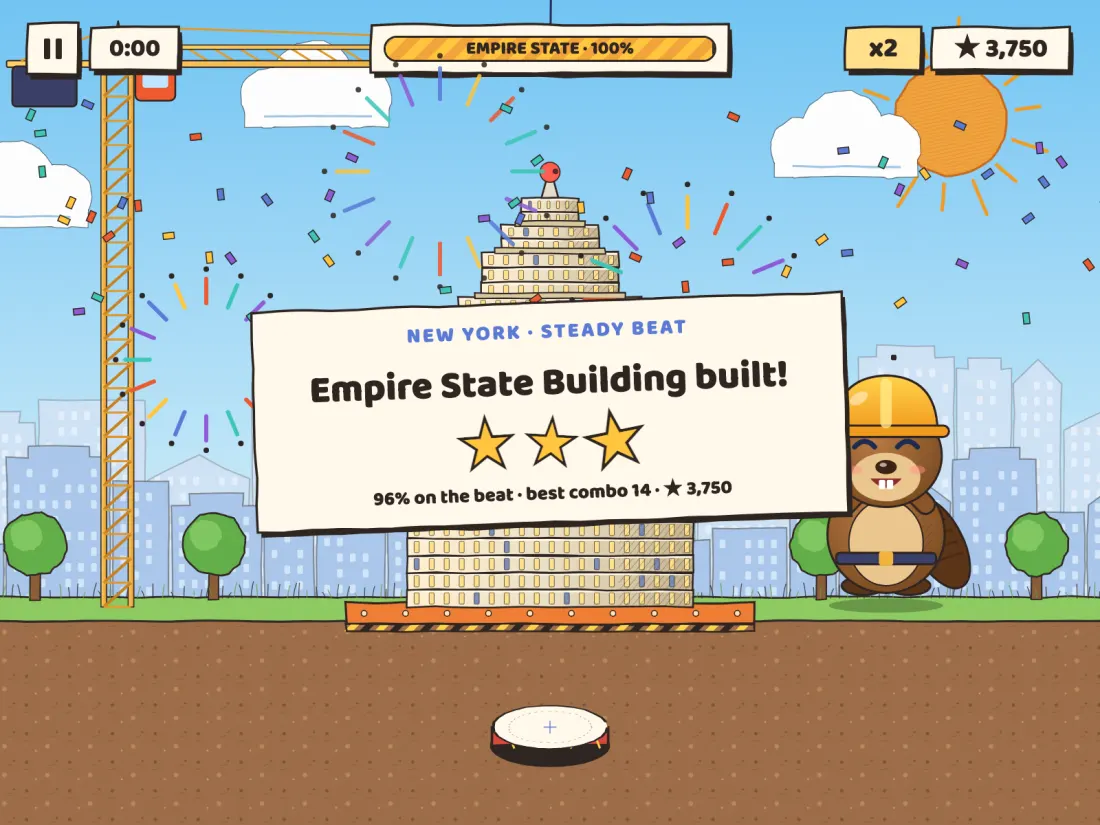
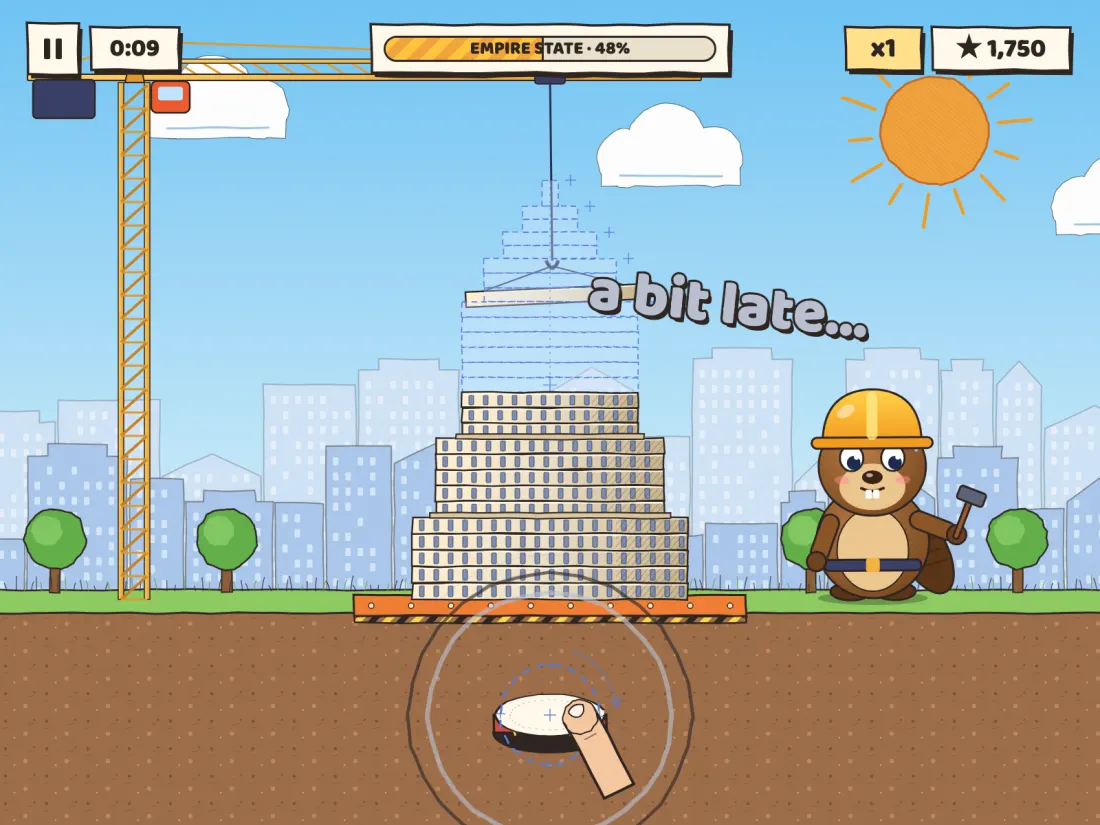
Build to the Beat gameplay: a monument rising as the child taps, with a Perfect rating on screen
1

Build to the Beat

Every monument is built one block per beat. The child taps on the beat and the tower rises, with Perfect, Good and Miss feedback on every tap. Visual and audio beat markers fade as the child stays on the beat, so the game steadily shifts the work from following the cue to holding an internal beat.

  • Cue fading. Beat markers fade as accuracy rises and return when it drops, at a rate set per child.
  • Tiers. Simple beat, then complex beat, then hidden beat.
  • Logged per tap. Timing error (mean and SD), vector strength, hit rate and the final cue level.
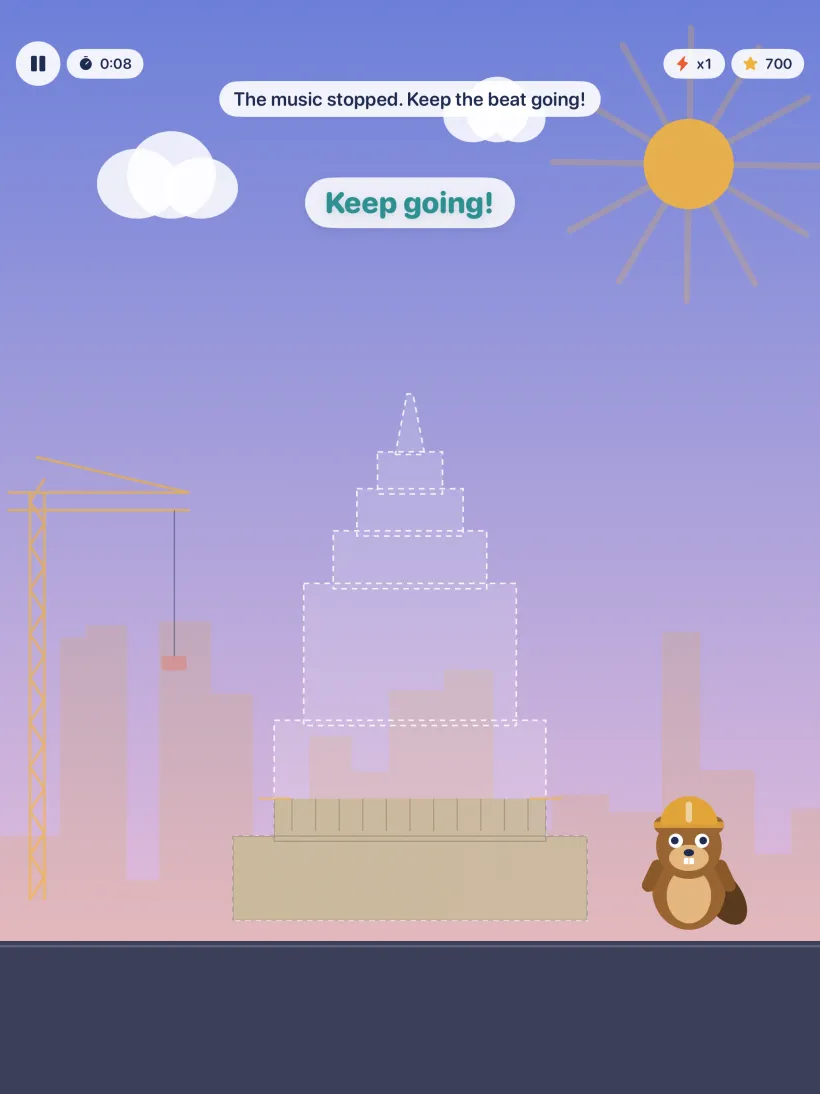
Keep the Beat: the music has stopped and the screen prompts the child to keep the beat going
2

Keep the Beat

The classic synchronization and continuation paradigm, made into a game. The child taps along with the music. The music stops and the child keeps the beat going in silence. The music returns at a new tempo and the child finds it again.

  • Three phases. Synchronization, silent continuation, tempo shifted resynchronization.
  • Logged per round. Drift percentage, interval variability (CV) percentage, beats to resynchronize and silent beats reached.
  • Adapts. Silent beat length and tempo shift follow the child's performance.
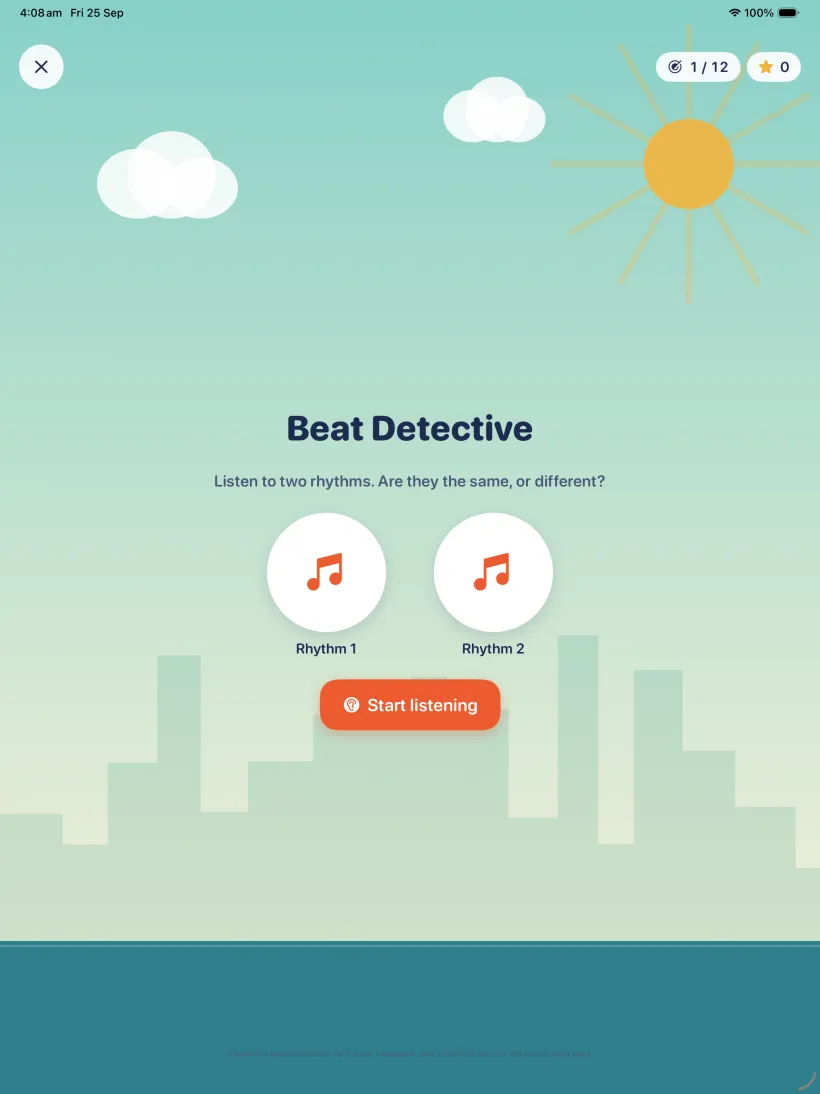
Beat Detective: the child listens to two rhythms and decides whether they are the same or different
3

Beat Detective

The child listens to two rhythms and decides whether they are the same or different. This is the discrimination paradigm of Wieland, McAuley, Dilley and Chang (2015), laddered the way the rhythm literature lays it out: simple metric, then complex metric, then nonmetric.

  • Laddered difficulty. Simple metric to complex metric to nonmetric, stepped by a two down, one up staircase.
  • Logged per trial. Accuracy, final level, response time, and the exact patterns of every trial.

Paradigm: Wieland, McAuley, Dilley and Chang, 2015. Rhythm types after Grahn and Brett.

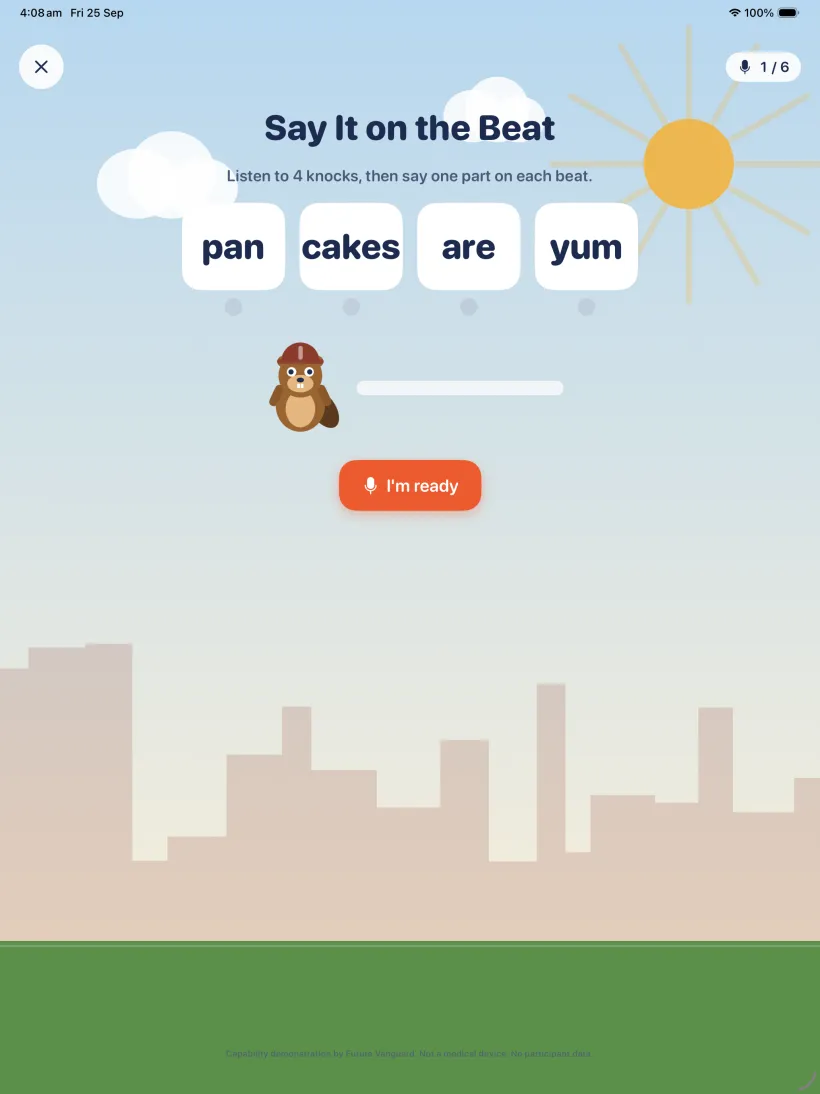
Say It on the Beat: four words on screen, one per beat, with a count-in
4

Say It on the Beat

A speech rhythm probe. The game counts in with four knocks, then the child says a word or phrase one part on each beat. The iPad finds each syllable onset on the device and measures how far it lands from the beat.

  • On-device timing. Syllable to beat timing error and on-beat rate, computed locally.
  • An assessment probe. It gives the study a speech rhythm measure alongside the nonspeech tasks. It is not a fluency-shaping drill.

Built to be played for six weeks. Streaks, stars, a road trip passport that collects a stamp for every monument, a map of progress, and a session that resumes at the right level. Engagement design comes from our experience building Wheelingo, a gamified learning app, and it is tuned for children who would rather be playing than practicing.

How it maps to the study

Your requirements, one by one.

The UM research team and its collaborating experts provide the theoretical framework. Future Vanguard translates that framework into mechanics, code, art, audio, speech and performance technology, security, testing, training and support.

UM requirementWhat we build
Speech and nonspeech rhythm activitiesThree nonspeech activities (Build to the Beat, Keep the Beat, Beat Detective) and one speech rhythm activity (Say It on the Beat), all in one game.
Progressive levels of difficultyTiered ladders inside every activity: cue fading, simple to complex to hidden beat, simple metric to complex metric to nonmetric, and longer silences.
Performance based adjustmentDifficulty is set per child and per module: hit window, cue fade rate, Beat Detective level, silent beat length and tempo shift. Every change is written to the session record.
At least 30 minutes a day, 3 to 5 days a week, for 6 weeksShort chunks, module rotation, streaks, a passport and a road trip map. The grown-ups area sets the daily goal, target days and study length, and adherence is logged against them.
Instructions, feedback and progress indicators; resume at the right levelClear spoken and on-screen instructions, instant feedback on every tap, and progress shown on the map. A returning child resumes exactly where the adaptive engine left them.
Gameplay, adherence and performance dataMillisecond tap timing on the audio clock, per-trial logs, minutes per session, days per week and difficulty trajectory. See the next section.
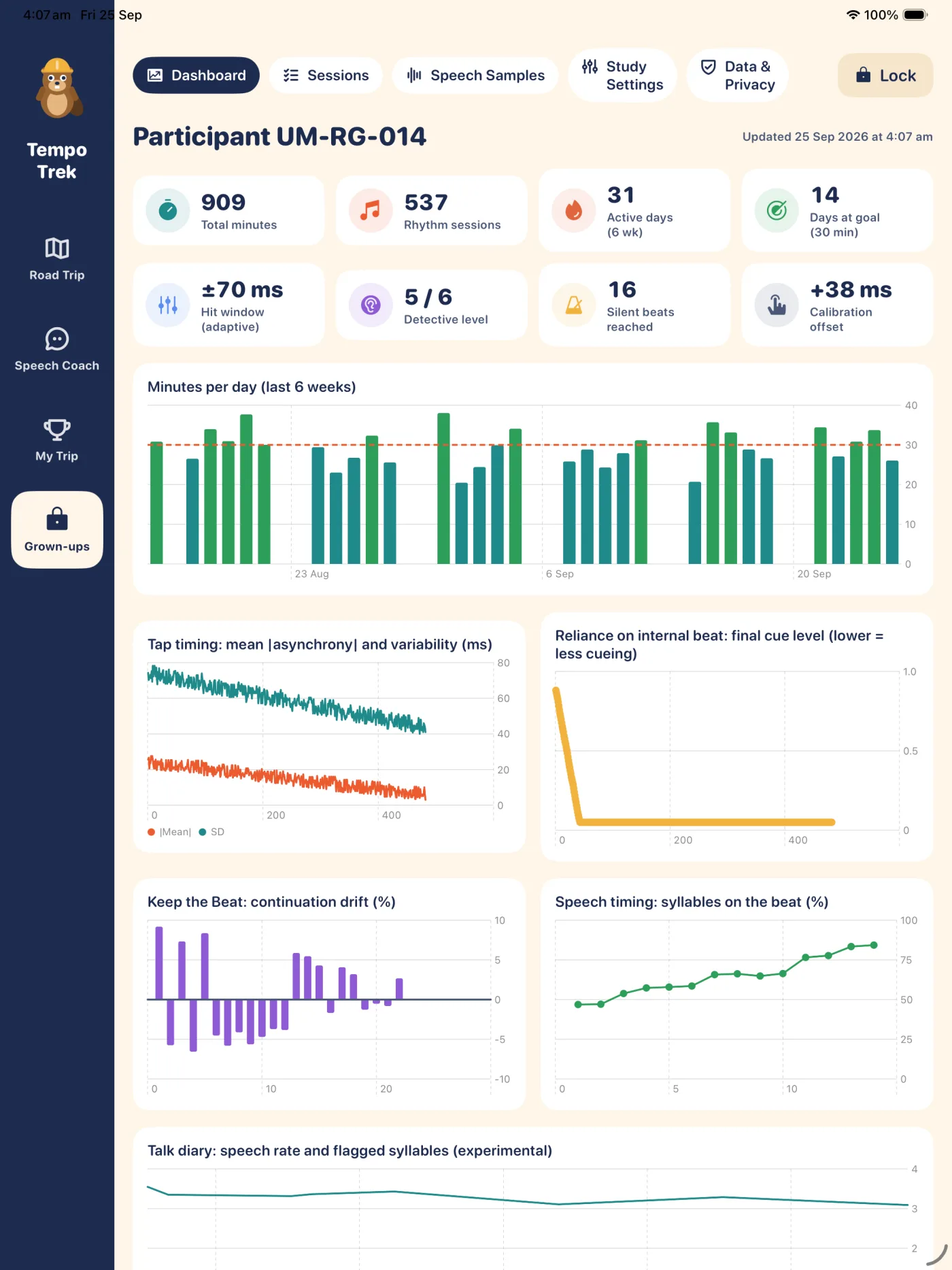
Near real time researcher dashboard (Year 3)A researcher dashboard is already running in the iPad build, with a participant summary, minutes per day, timing trends and speech samples. In Year 3 we extend it into the internal study dashboard UM describes, fed by the study data pipeline.
Authorized export in UM approved formatsPasscode protected export of JSON and CSV files for sessions, trials and speech. Exports carry the participant ID only.
IRB, privacy, security and accessibilityOn-device protected storage, no network calls in the demonstration build, a study mode that isolates the intervention, and VoiceOver, Dynamic Type and Reduce Motion support. Architecture, data flow, data field and security control documentation is produced for UM review.
Iterative refinement from researcher, clinician and participant feedbackEvery quarter of the plan has a feedback loop with the UM team. Difficulty parameters are configurable, so refinements land as settings and content, not rewrites. Updates preserve existing data.
Research-grade data

Every tap is data.

The game is a measurement instrument first and a game second, and the child never has to know. Timing is captured on the audio clock, corrected per device with a short tap-to-calibrate step, and written to a per-trial log.

Audio clock

Tap timestamps on the audio host clock, with a BAASTA style tap-to-calibrate step for each device and child.

Per trial

One row per trial. Every pattern, response, timing error and difficulty setting is recoverable.

Per change

Each adaptive difficulty change is written to the session record, so the intervention dose is reconstructable.

JSON + CSV

Sessions, trials and speech files, exported by an authorized adult, with the participant ID only.

Asynchrony mean and SD per tap, vector strength as a consistency score, hit rate, and the final beat cue level, which shows how far the child relies on the internal beat.

Drift percentage and interval variability (CV) percentage during silence, silent beats reached, and the number of beats needed to resynchronize after a tempo shift.

Accuracy by rhythm complexity, final staircase level, response time, and the full staircase path with every trial's patterns.

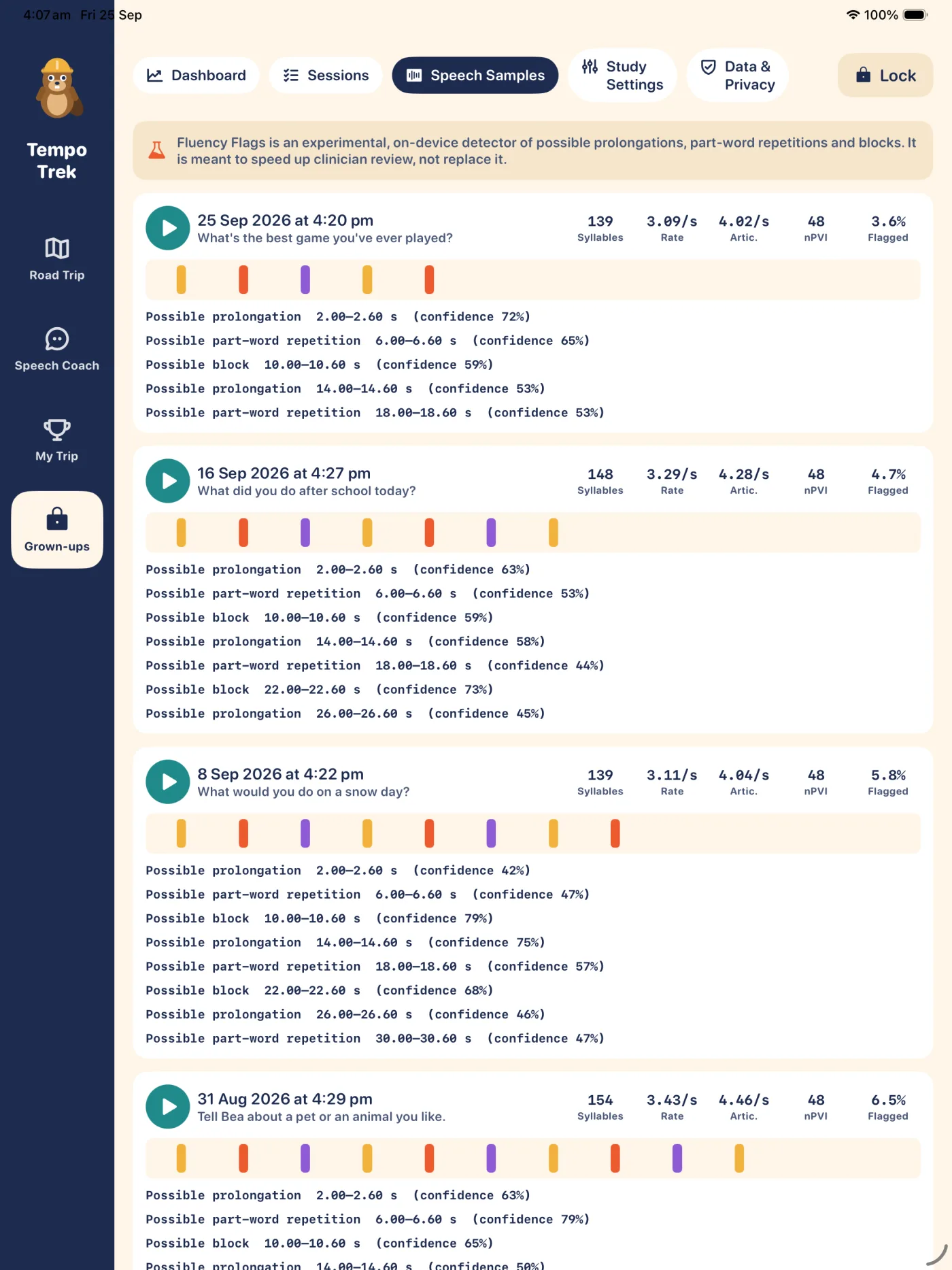
Syllable onset asynchrony against the beat, on-beat rate, speech rate, articulation rate, pauses and rhythm variability (nPVI).

Minutes per session, days per week, active days against the target, silent beats reached and difficulty trajectory over the six weeks.

Validated as we build

  • Autoplay bot. A built-in bot plays the game with human-like timing noise, so the pipeline from tap to exported file is tested end to end against known input: a 30 ms injected tapping spread is recorded at 29.9 ms.
  • DSP validation suite. The speech timing code is run against controlled synthetic cases (fluent, prolongation, part-word repetition, block) and real speech recordings.
  • Six weeks of sample data. A seeded demo mode fills the dashboard with six weeks of realistic synthetic sessions, so researchers can judge the reports before any child plays.
Researcher dashboard showing minutes, rhythm sessions, active days, hit window, tap timing trends and continuation drift charts for a sample participant
Researcher dashboard in the iPad build: timing trends, cue reliance, continuation drift and speech timing over six weeks. Synthetic sample data, no participant data.
Speech samples list with syllable counts, speech rate, articulation rate, nPVI and a timeline of flagged events
Speech samples view: syllables, speech rate, articulation rate, nPVI and a timeline of experimental flags for researcher review. Synthetic sample data.
Speech technology

Timing measures from day one.

Our speech technology measures when and how a child speaks, and it does not depend on recognizing which words were said. That keeps it robust for atypical, disfluent and child speech, where word recognition tends to tidy up the very events a study cares about.

Streaming analyzer

A 16 kHz analyzer working in 10 ms frames: loudness, voicing, pitch with octave error protection, and eight spectral bands.

Syllable timing

Syllable onsets found from the loudness envelope in the De Jong and Wempe tradition, giving speech rate, articulation rate, pauses and nPVI.

On the device

Written in house on Apple's Accelerate framework. Live audio is analyzed on the iPad and not stored.

Experimental

Fluency Flags, for researcher review only

Fluency Flags is an experimental, on-device detector of possible prolongations, part-word repetitions and blocks. It exists to speed up clinician review: it marks likely events and a first estimate of the share of syllables affected, and a clinician confirms. The flags are never shown to the child, so the game stays a rhythm game and never turns into fluency therapy.

We frame detection as a research deliverable for Years 2 and 3. Detectors for children's speech are still an open research area, so we develop and validate ours alongside your study. With UM and IRB approval, models are trained and validated on study audio and measured against clinician scored samples, and the accuracy is reported as measured.

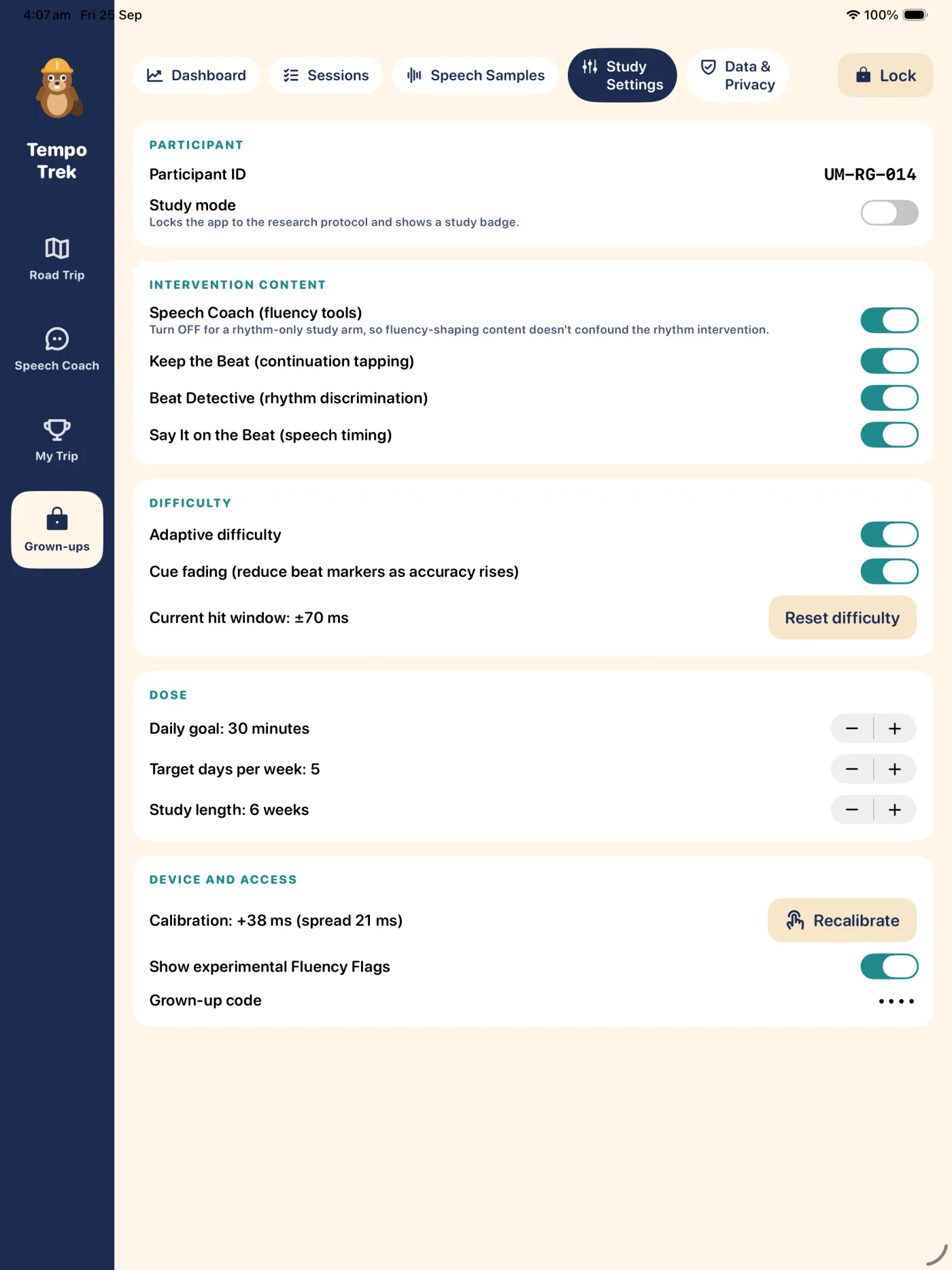
Study settings screen with a study mode switch, module switches, difficulty controls, dose settings and a switch for experimental Fluency Flags
Grown-ups area: study mode, module switches, difficulty and dose settings, and the switch for researcher-only Fluency Flags.

Deeper prosody analysis stays with your team. Pitch contour, voice quality and similar measures can be run offline on exported session audio with established peer-reviewed tools, and the export format is built for that.

Data, privacy, security and accessibility

Built for a study with children.

The demonstration build collects nothing and sends nothing. The proposal extends that foundation into UM approved environments.

Protected on the iPad

All game progress, timing results and recordings live inside the app, protected by iOS Data Protection (complete).

No network, no analytics

No accounts, no advertising, no tracking and no network calls. Nothing leaves the device unless an authorized adult exports it.

Participant ID exports

Exports carry the participant ID only, never the child's name. A passcode protects reports, settings, export and delete.

UM approved environment

In our proposal, study data moves from the iPad into a UM approved, IRB reviewed environment, with a REDCap based path for capture and sync, using the authentication, access control, encryption, backup and recovery UM Information Assurance requires.

Study mode

One switch turns off the Speech Coach content, so a rhythm-only study arm is never confounded by speech strategy lessons. Module switches give researchers the same control over each activity.

Accessible by design

VoiceOver labels, Dynamic Type and Reduce Motion support, with WCAG 2.1 AA as the reference standard and documentation ready for UM review.

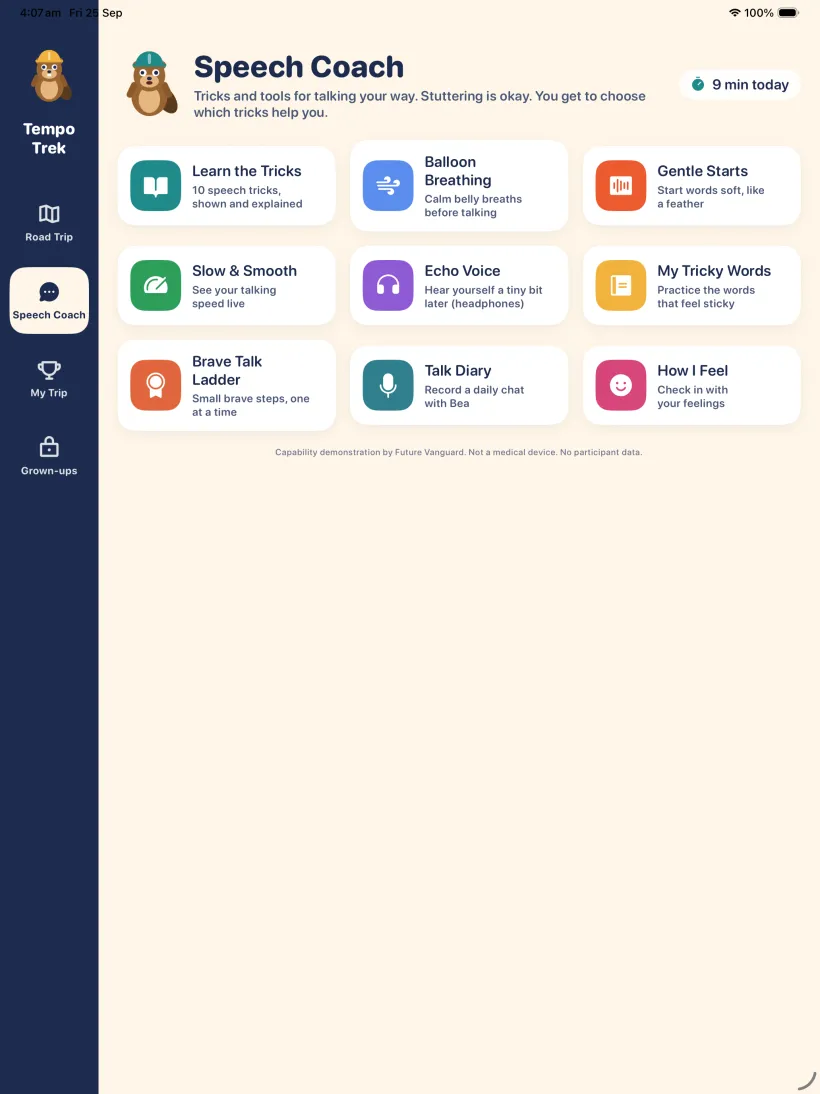
Speech Coach home screen with lesson tiles for belly breathing, gentle starts, slow and smooth speech and more
The optional Speech Coach side of the app, which a researcher can switch off for a rhythm-only arm.

A second mode the study controls.

Tempo Trek has two sides. Rhythm Quest is the research intervention. Speech Coach is a set of child friendly speech lessons: ten animated lessons, balloon breathing, a gentle start meter, a live speed meter, a list of the child's own tricky words, a brave talk ladder, a talk diary and a feelings check in.

The UM team decides whether Speech Coach is part of any arm of the study. When it is off, it is off completely.

Five-year plan

Your timeline, quarter by quarter.

Our plan mirrors the year by year and quarter by quarter timeline in UM's own scope, from the November 2026 start to closeout in 2031. Milestone dates stay open to adjustment by mutual agreement with the research team.

Year 1

Requirements, design and initial development
  1. Q1Meet the UM study team on scientific rationale, goals, workflow and game needs.
  2. Q2Translate study needs into prototype, speech technology, progression, UX and data requirements. Feedback from UM.
  3. Q3Build and integrate initial prototype modules, foundational speech technology and data capture. Iterative review with UM.
  4. Q4Finalize specifications and deliver an initial functional prototype for piloting by the UM team.

Year 2

Completion, integration and study readiness
  1. Q1Incorporate feedback from piloting sessions.
  2. Q2Complete the remaining modules, progression, speech technology and research data capabilities.
  3. Q3Usability testing, refinement and bug resolution. Final preparation for child participants.
  4. Q4Deliver the study ready game for UM acceptance. Enrollment and study launch.

Year 3

Study launch and technical support
  1. Q1Support launch and enrollment. Begin the internal research dashboard.
  2. Q2Iterate the dashboard with UM input and expand metrics and visualization. Ongoing technical support.
  3. Q3Deliver the fully functional internal study dashboard. Continue support and refinement.
  4. Q4Maintain reliable operation of game and dashboard. Agreed minor refinements and documentation.

Year 4

Continued study support and maintenance
  1. Q1Technical support and maintenance for enrollment, intervention delivery, data collection and dashboard use.
  2. Q2Agreed minor maintenance updates and corrections, without altering the study intervention.
  3. Q3Resolve issues affecting gameplay, speech technology, data workflows or the dashboard.
  4. Q4Stable operation and updated technical and research documentation.

Year 5

Final quality assurance and closeout
  1. Q1Technical support and maintenance during enrollment and data collection.
  2. Q2Support through completion of participant data collection.
  3. Q3Final quality assurance. Confirm accessibility and integrity of research data and project materials.
  4. Q4Complete project closeout.

Orange markers show the delivery milestones: the Year 1 prototype, the Year 2 study ready game, the Year 3 dashboard and closeout.

Team

A small team that builds it end to end.

Future Vanguard LLC is a 100 percent woman-owned American small business. The people you meet in design meetings are the people who write and ship the software.

Chief Executive Officer

Raleigh Cortez

Sole owner, Future Vanguard LLC

Accountable owner of delivery and scope conformance, and your point of contact for the project.

raleigh.cortez@futurevanguard.net

Chief Technology Officer

Carlos Guerrero Pogan

Architect and builder of Tempo Trek

Built the Tempo Trek iPad app. Architected Cared, an AI clinical voice to note app in production, and built Wheelingo, a gamified learning app.

carlos.guerrero@futurevanguard.net

VA GRECC Agitation 360

A current federal contract being performed: a clinical research training application built with an academic geriatric research team (RFQ 36C25626Q1008, awarded to Future Vanguard on September 3, 2026).

Cared

An AI clinical voice to note app in production. A secure voice capture and speech AI pipeline for sensitive clinical audio.

Wheelingo

A gamified learning app with progression, streaks and XP. The engagement design behind Tempo Trek's six week play loop.

Try it

Put it in your hands.

Tempo Trek runs on iPad in both orientations. The iPad capability demonstration is provided to the evaluation team on request through TestFlight, and includes a demo mode with six weeks of synthetic sample data so the researcher reports can be explored right away.

  1. Write to either address below and we send the TestFlight invitation.
  2. Open the app, play each of the four activities, and watch the sample dashboard fill.
  3. Open Grown-ups, switch on study mode and export the JSON and CSV files.
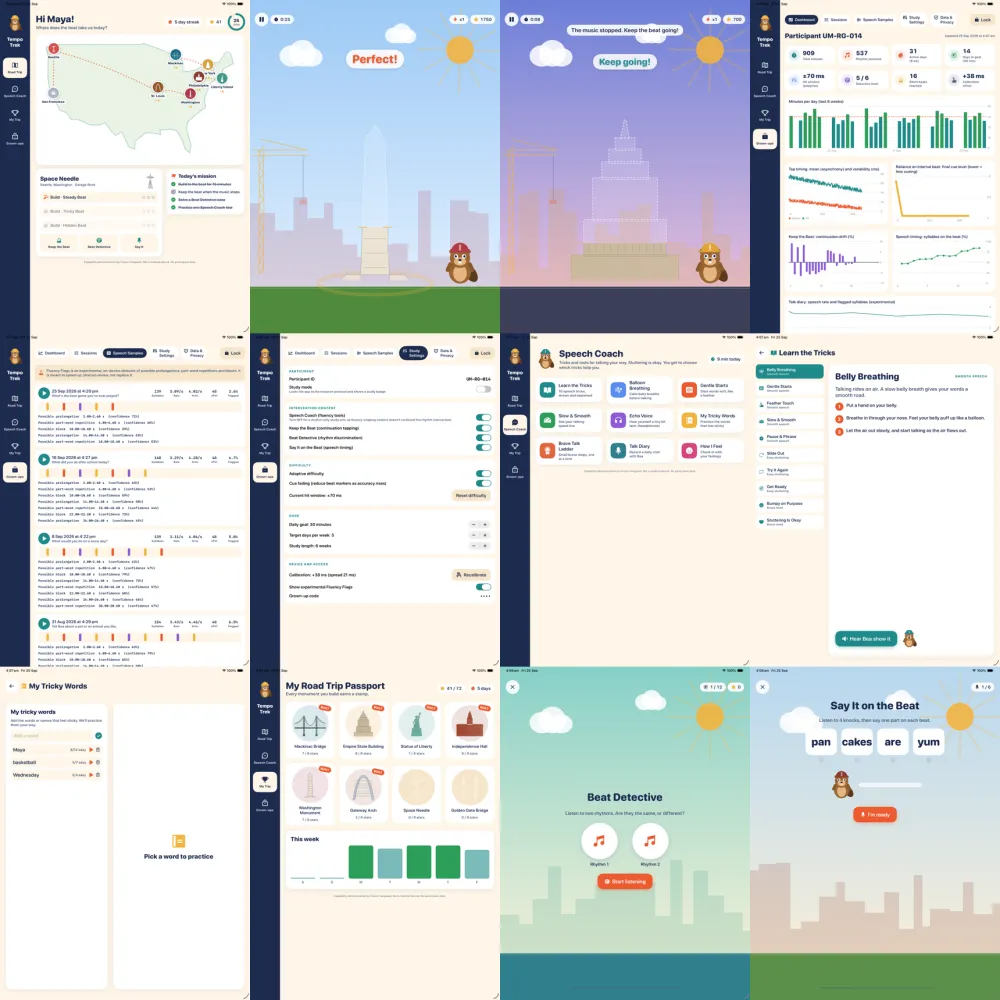
Overview of Tempo Trek screens: road trip map, gameplay, dashboard, speech coach and passport
The app at a glance.